


The Challenge
The Western Washington Phase II Municipal Stormwater Permit is a state-mandated program designed to protect local rivers and lakes by requiring cities to manage polluted runoff from rain and snowmelt. A critical part of this permit is the Stormwater Management for Existing Development (SMED) requirement, which focuses on upgrading older, "under-regulated" neighborhoods that were built before modern environmental standards were in place. To meet these goals, the City of Redmond has identified the Monticello Creek watershed as a top priority for restoration due to its high environmental value and potential for recovery. The City is now implementing a targeted plan to retrofit specific sites with advanced drainage tools—such as rain gardens, permeable pavement, and smart pond controls—to ensure the creek remains a healthy habitat for years to come.
The Solution
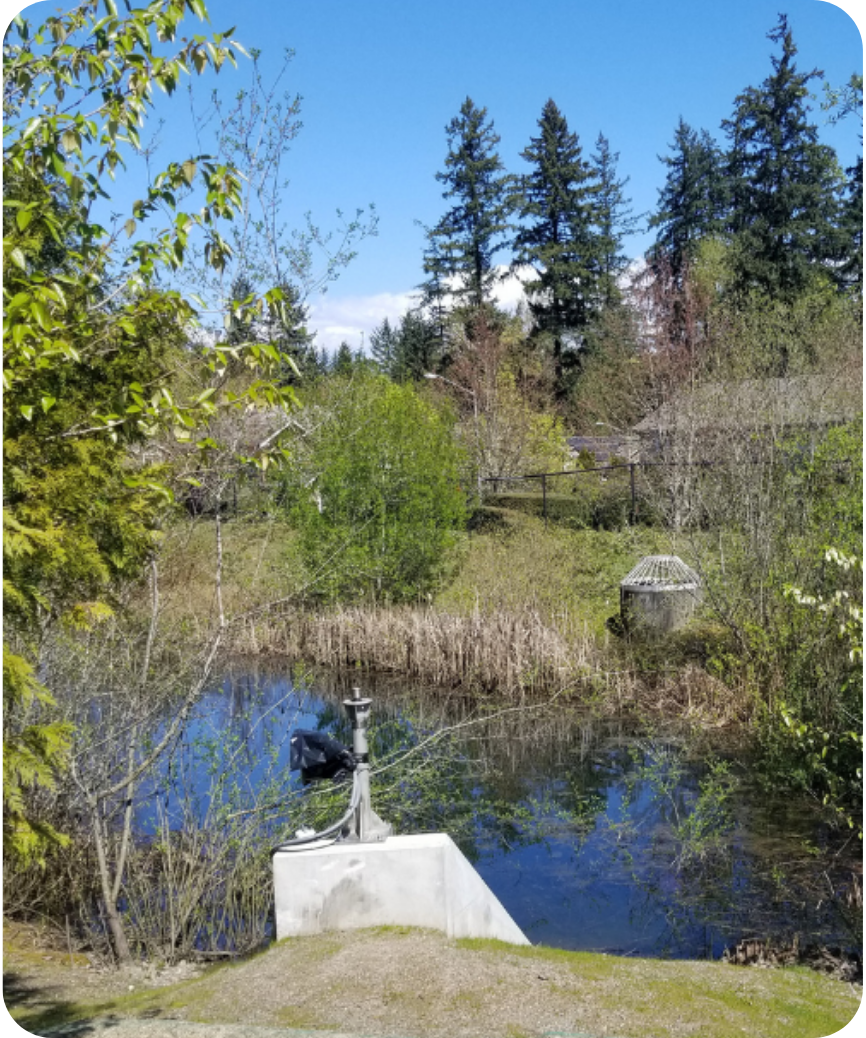
As part of their SMED approach, the City of Redmond pursued Continuous Monitoring and Adaptive Control (CMAC) retrofits as a cost-effective way to improve stream health by modernizing existing stormwater infrastructure. Engineers used hydrological modeling to compare as-built conditions against CMAC-mitigated scenarios, evaluating metrics such as basin area managed, improvements in flow durations, and the reduction of "high-pulse" events that cause stream flashiness. Ultimately, the City identified Wynstone Pond and Cogan Allen Pond as the best sites for retrofitting because they manage the largest basin areas, showed significant potential for improving flow durations, and were currently the most undersized relative to modern environmental standards.
Results
The City of Redmond successfully implemented Continuous Monitoring and Adaptive Control (CMAC) retrofits at Cogan Allen East and Wynstone Ponds, achieving significant improvements in watershed health and regulatory compliance. These sites were prioritized because they were undersized relative to modern standards and exhibited high-pulse flow rates, thereby offering the greatest potential to reduce "flashiness" in the Monticello Creek watershed. A critical factor in the project's success was the early involvement of Operations and Maintenance staff, whose design contributions prevented costly scope changes and fostered long term ownership of the new infrastructure.
Analysis of the retrofits reveals substantial progress toward state Stormwater Management for Existing Development (SMED) requirements. In 2025, observations indicate that system outflows exceeded 0.1 cfs only 1–2% of the time which is much lower than previous "existing conditions". This indicates that the system is effectively protecting the downstream environment from high flow rates. Collectively, the 2 sites treated 15.06 acres of the Monticello Creek watershed and earned the City of Redmond 1.96 equivalent acres for their SMED requirement.
